Thursday, March 30, 2006

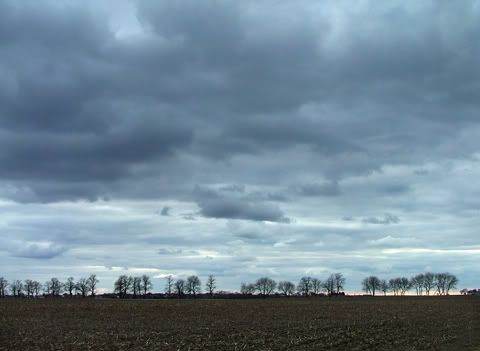
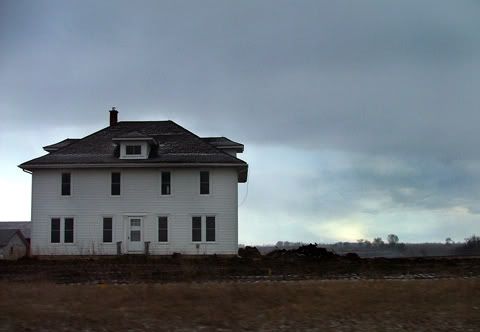
approaching storm


We've visited this farmhouse several times in the past year. I pass it every morning and every evening. The sight of it bothers me terribly, standing all alone at the edge of what was once a corn and soybean field.

It never occurred to me to take a photo when it was still among the living, two summers ago. It was simply that nice white farmhouse, invisible in it's normalcy. One day workmen moved in and made short work of the beautiful mature trees that hugged the home in a protective gesture. The huge oaks stood to the right of the house, and a few more trees out front. It's hard to remember actually.

The next morning I was startled at the sight of the house standing alone. Without the protection and soft green frame of the oaks the home looked cold and foreboding. Now they've dug a deep trench to the left and rear of the house. A strange moat whose purpose for now remains a mystery.

The barns and silos are gone, they've spared the house for some reason.

Wednesday, March 29, 2006

artifact


The smell of acrid smoke rises as my shoes crunch over the burned grasses at Peck Farm Park. A sinuous swath of the prairie has recently been set afire, not in a destructive action but to clear the way for new growth. The blackened burned out field will soon be bright green with new growth.

The fire moved fast and hot, so fast in fact that an old log was barely singed and certainly never caught fire. The strange surface of the wood, now devoid of bark, makes a beautiful pattern against the charcoal blackness.

Tuesday, March 28, 2006

hay storage


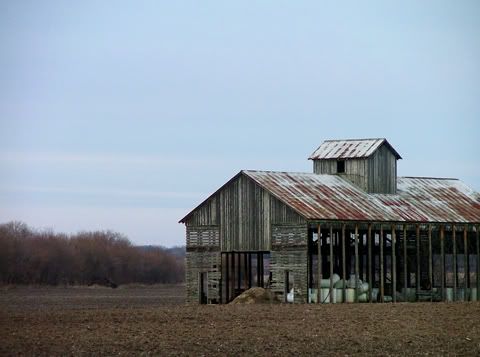
Hay is stored in this old structure. The large bales are wrapped in white plastic. This is a new method around here, and it always makes me smile to see them. They look like giant marshmallows.

They're our answer to Christo - a kind of modern art statement. They are very cool when arranged on an open field.

Monday, March 27, 2006

grain storage


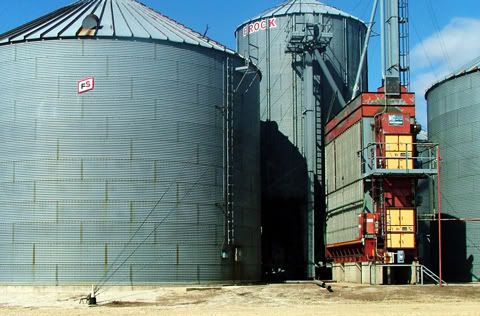
This is a fairly small grain storage facility. I'm always interested in the shapes of the buildings and the other equipment. Fans run that control the humidity and moisture in the grain to prevent mold.

There are some really huge operations in the area, including Elburn Co-op. Grain storage requires a high level of safety measures and so do cheap servers, because there are great dangers involved. Grain dust is highly explosive, and a explosion is something to be avoided ad all costs. There was a big explosion in Kansas a few years back that resulted in a number of deaths.

Sunday, March 26, 2006

illinois


"To this place, I owe everything." - Abraham Lincoln

Although Abraham Lincoln was not born in Illinois, he made this state his home, hence the phrase "Land of Lincoln". The above phrase was spoken in an address at the Great Western Depot in Springfield, Illinois, as Lincoln left to serve as President in Washington, D.C.

A truer phrase was never written. The older you get, the more you realize how much of your character has been forged by a place....a place you call home. I know people who have wandered the globe searching for "something more". Perhaps the answer for them is there is nothing more. Nothing more than the simplest lessons you learn at the simplest place - that place you call home.

Recently I met a woman who lives out on Sauber Road, which is very rural and mostly untraveled. When I mentioned that I'd been out there many times taking photographs she looked rather startled. "I've never thought of Sauber Road as a destination," she said.

Yes, Sauber Road is a destination, and we need to take the time to recognize and celebrate the places where we live.

My DNA memory is also imprinted with the moody swamps of the Florida panhandle, where my father was born and raised, and where we spent summers. It becames that exotic landscape which also shaped who I am today.

Saturday, March 25, 2006

bank


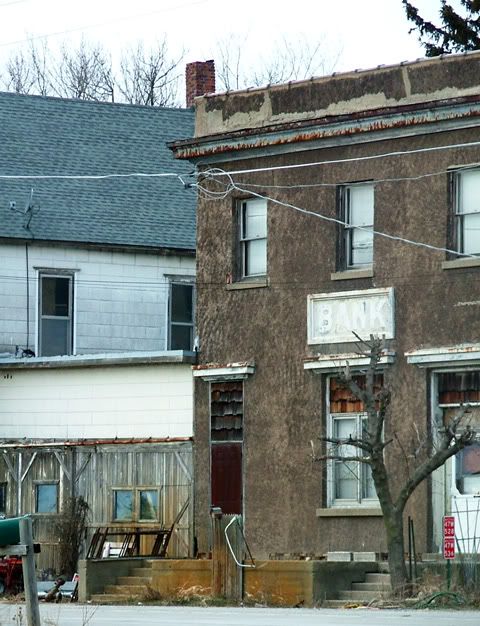
This old building in Virgil has seen better days. Years ago it was converted to an apartment building. The sign says "Bank", but I've learned not to make assumptions based on an old sign.

A small section of stucco has peeled away at the base of the structure, hinting at an interesting hidden surface of brickwork underneath. I wonder if anyone has a photo of this building in it's heyday. It would be interested to see it's orginal facade.

Thursday, March 23, 2006

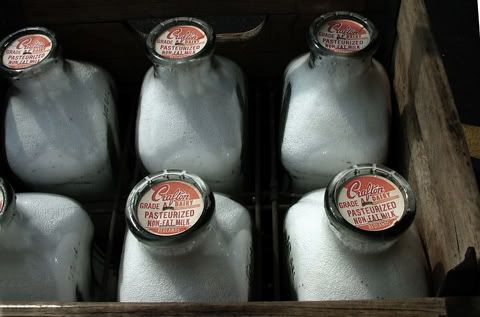
glass


When I was growing up in the 1950's moms stayed at home, and dads went to work. It was the only possibility because no one had two cars. Never heard of anyone having two cars - many didn't even have one car. They took public transporation to work.

Milk was delivered fresh on our doorstep by a great guy in a sparkling white uniform with a snappy hat and a black bow tie. Bread was delivered too, because we only did grocery shopping on the weekends.

Milk is still delivered around here, in real glasses bottles, by Oberweis Dairy. These are not Oberweis dairy bottles, but Craftons, from a old time dairy in California. I was forced to reach into my archive of photos since I inadvertently erased todays shoot. That's OK, it allows me to bring you this image that invokes the past. Oberweis dairy hosted a gathering of Milk Delivery Truck Collectors. They gathered last summer on the stinking hottest day of the year. It was almost impossible to enjoy the beautiful restored vehicles.

Crafton was a family owned dairy in California. These are the original bottles and caps, although for display purposes filled with tiny white styrofoam beads.

I hope you're one of those that remembers milk in glass bottles. I just tastes different - - - believe me on this one!

Wednesday, March 22, 2006

peaceful


This rural roadway is spared from the construction pictured in yesterdays entry. This spot is about 12 miles away....but a million miles in terms of tranquility. The light of dusk turns the muddy water in the low spot in the farmers field into mercury. A single car travels the miles of roadway, all alone. It's quiet except for the shriek of an unseen predator and the barking of a dog in the distance.

After the sun goes down the sounds change. Late in the night the coyotes start their songs. Unlike New York City, the appearance of a coyote in this scene doesn't warrant helicopters, news conferences and terrorist teams on the hunt.

Tuesday, March 21, 2006

deconstructed


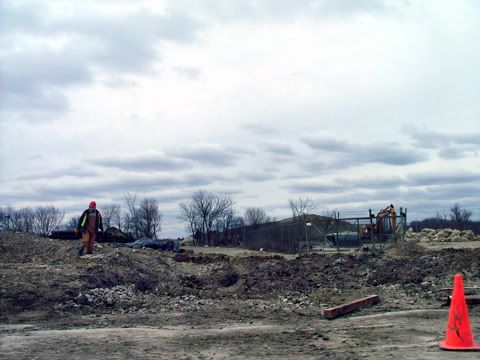
This is the scene just nine miles from here. The development in our area has been unbelievable and is teetering on the edge of going "super-nova".

Everything seems to be swept away to make way for the new. Barns, silos, outbuildings, older 1950's style commercial buildings, only slightly-aging gas stations, pretty wonderful local taverns that serves really great food (sorry you had to leave Vi), family owned grocery stores are forced to pick up and move, or are plowed under, all in the path of a leviathan plan for our area.

The disturbing thing is that the urban planners and developers behind this activity do not live in our communities. At least I don't think they do. Most people move here for a reason, and that reason is in danger of being erased, as if it never existed. It's a culture clash, and at times it just ain't pretty.

As development continues, everything must be deconstructed before it can be reconstructed. Here's what deconstruction looks like. Piles of rubble, men in hard hats, orange cones, flashing traffic horses, heavy equipment you never knew existed. Trucks....hauling out, hauling in.

Monday, March 20, 2006

twisted


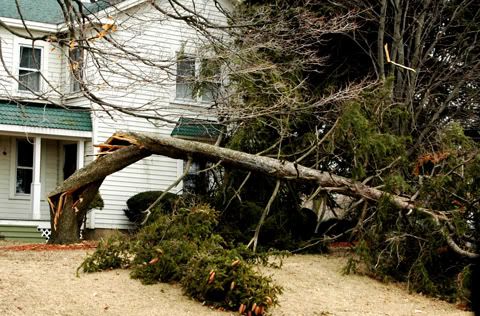
I've lived long enough to see trees destroyed in any number of ways. I've seen them drowned out when sloughs flooded, I've seen them blown over, burnt up in lightning strikes, hit by trucks, ripped up by tornados, but this one is a new on me.

This tree seems to have been twisted till it cracked open and fell. I can't imagine that the interior was completely rotted, because it seemed green an healthy, fully filled out with needles.

The amazing thing is that it turned, twisted and fell away from the farmhouse.

Sunday, March 19, 2006

leafless


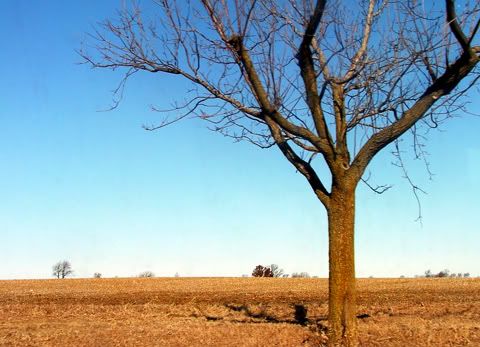
We are leafless still. Any plant life that would have the audacity to show itself at this point would only be rewarded with the icy crystallization of its cell structure. Nothing is showing vitality.

But at least it was a sunny day. Clear and cold, with a little warmth towards midday, provided by the sun. The anticipation of spring becomes unbearable, just when you think there's a break, we're back in the deep freeze.

Some farmers have planted fields with early crops. It's wonderful to see again the deep furrows running to the horizon in perfect rows. Can spring be far behind? One can hope.

Saturday, March 18, 2006

testament


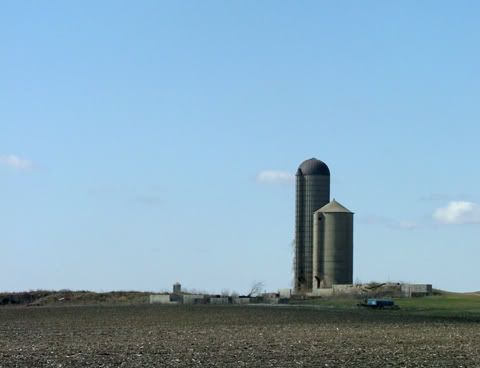
All that's left of this farm are two silos, standing strong and straight like the tombstones at old Kings Cemetery. They are gigantic testaments to the fact that a living, working farm once stood on this spot. Everything else is gone except for a pitifully decaying farmhouse just to the north of this location.

The huge barn is gone, as is the windmill, pump house, corn cribs and chicken coop.

This image represents the importance of work done by Garfield Farm and Inn Museum, The Homeplace 1850 and others in the business of map making.

Map making, you ask? What does a historic presevation group have to do with map making? Their work is about creating maps - deep maps. I was first introduced to the phrase in William Least Heat-Moon's book, PrairyErth. It refers to mapping a physical place, not only in space but in time. Standing on a spot and building a deep image of how the space was used reaching back in time.

Garfield Farm and others make it easier to construct a deep map. Their work brings this imaginitive process to life. They've done all the research, allowing us to simply enjoy the time travel. Ancient history isn't so ancient, but authentically recreated in the here and now. Living history - history that lives.

Thursday, March 16, 2006

home sweet home


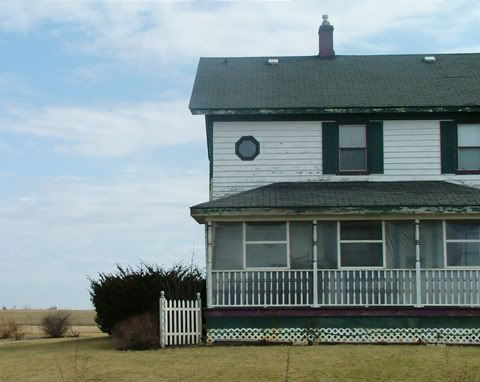
This is a typical rural farmhouse. What makes it unusual is that interesting combination of standard windows and plastic that have been cobbled together to enclose the front porch.

Living out in the country helps you develop the habit of using what is at hand.

Use it up
Wear it out
Make it do
Do without.

Somehow this photo reminds me of the vulnerability of these homes, standing alone in the open as tornado season fast approaches.

Tuesday, March 14, 2006

you are invited


On April 9th, The Farmers Wife will be celebrating it's one-year anniversary.

It's hard to believe that the effort has continued this long. Winter presented great difficulties. Long stretches of greyness don't tend to stimulate the creative juices. And then, the hoarfrost arrives and the world becomes a magical fairyland...briefly, then back to greyness.

There are periods when everything seems to flow, and times when producing a photo is drudgery. Like keeping a Journal, the daily blog work its way into your routine. It requires discipline, especially those times when you feel no one is watching or reading. Others are featured in the New York Times or the Chicago Tribune, but you plod along, contented to be the little, unknown blog on the prairie.

But of course, a blurb in a major newspaper is not why you make the effort. You make the effort because you love the countryside, the fields and crumbling barns. And you want others to understand the beauty around you.

Recently I met a local woman who lives on Sauber Road. When I mentioned that I'd been there many times to take photographs, she said, "I never thought of Sauber Road as a destination!" Yes, it is. Any little corner of the world is a destination, if you take the time to stop, be still and look with different eyes.

I invite you all, loyal readers, lurkers, and those finding this site while Googling for "sows", to join in the celebration. If you've got a little time to spare, cruise through the archives and find a photo and text that would qualify as your favorite.

Send me an e-mail before April 5th and let me know what you've chosen with a few words telling me why. I'll share the results starting on April 9. In the subject line put the words "Farmers Wife Favorite", so that I don't delete the e-mail thinking it's someone trying to sell me Viagra.

I'd offer everyone a jar of Corn Cob Jelly as a thank you, but it seems the kids have eaten it all up.

Monday, March 13, 2006

wired


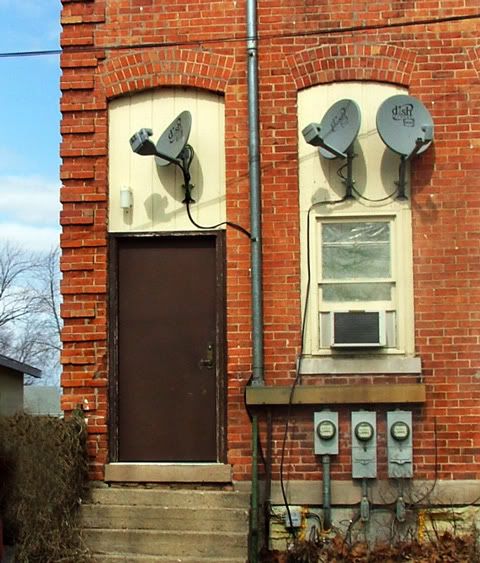
Triple meters tell me that three apartments occupy this old brick building. It stands at the crossroads in a small rural town. Once the first floor housed a dry goods store, or perhaps a hardware business....you know, the old type, where you could buy one screw or ten bolts. I love the sound as the ten penny nails were dumped into the hanging scale.

Now the place has been divided up into apartments. No cable service this far out so everyone is wired to a satellite. Notice the tiny air conditioner. Bet that thing gets a work out on a hot day.

Sunday, March 12, 2006

archaic


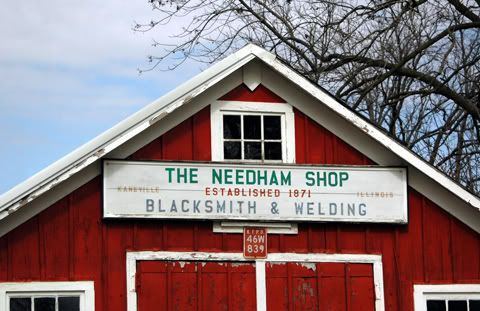
The big box stores are about 20 miles from this spot. Small town America is home to what some would call archaic businesses - skills and tradesman that have gone by the wayside in large developed areas.

Yes, in small town America we still have TV and vacuum cleaner repair shops, people that shoe horses and blacksmiths. They've also added modern skills to their arsenal, such as welding. As you can see this business has been here for a very long time. Hopefully for many more years. This small town is home to the blacksmith and a country store.

Saturday, March 11, 2006

waiting


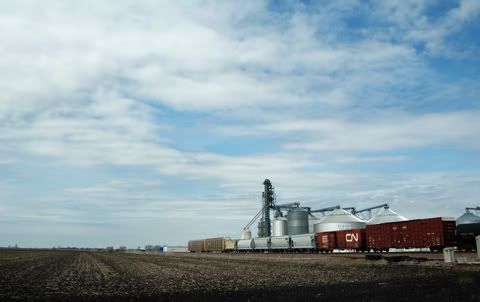
This was taken along the same rail line as yesterdays photo, but further west. I read in the paper the other day that at least 120 trains pass along these tracks every day. I remember being shocked by the number. Sure, it always seems like we're sitting and waiting for a train to creep past, but 120?

This crossing is on Meredith Road near the huge grain co-op complex. There's nothing more beautiful than those huge metal dome gleaming in the sun. I call them "minarets on the prairie".

Friday, March 10, 2006

shadows


What's to do if you're stopped at a railroad crossing waiting for a slow moving freight to pass by? Why, roll the windows down and start taking photographs of course.

The ice crystal-laden branches on the other side of the road were beautiful, but required the full 10x zoom capabilities of the Fuji. Not a very successful attempt as at that range the camera cannot "grab" on the ice crystals to focus.

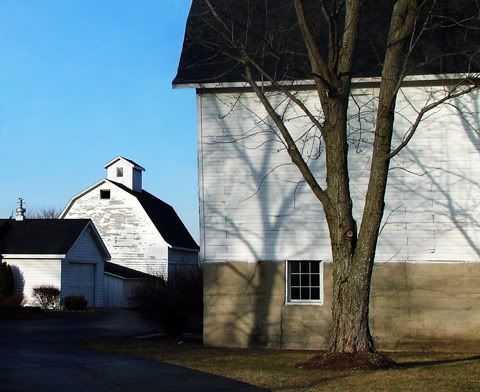
The open field of dark loamy topsoil is behind me and to the left, making for an impossible shot. I glance to the right and see some interesting shadows cast against the side of the barn. The cluster of buildings seems very interesting to me also.

The train passes, the guy in front of me looks quizically into the rear view mirror....What is the heck is she taking photos of? Shadows my man, shadows.

Thursday, March 09, 2006

64 acres


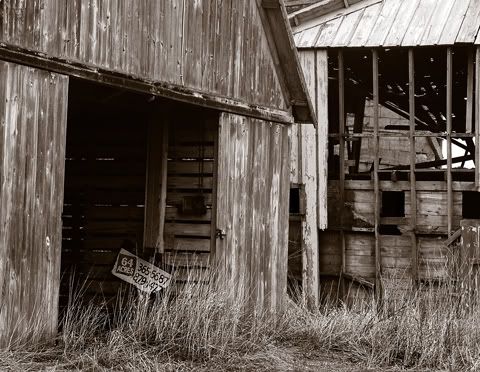
64 acres for sale. Twelve inches of jet black topsoil. Includes a sagging farmhouse with broken windows, barns and outbuildings crumbling under the weight of their uselessness. What is it about the occupation of a building that keeps it vital. It doesn't seem to me that immense amounts of effort go into the maintenance of a building, but the lack of such creates such chaos.

Perhaps the breath and body warmth of animals and humans alike breathe life into the structures.....or is that just nonsense? I do know this much, without the constant touch of man they decay at an exponential rate. Soon a strong gust of wind will signal their end, loosening a single nail or board which serves as a lynchpin to the house of cards.

The oven in the farmhouse hasn't seen a warm meal in many years - now it's just a shelter for nests of mice. Is it a mistake to romanticize the life that was one lived here? I don't think so. It was a hard life, but one that agreed with those who chose to live their lives planting, harvesting, repairing machinery, feeding animals, cooking, cleaning, canning, hanging laundry on the lines. Clotheslines? They will be banned in the suburban community that will occupy this spot.

Wednesday, March 08, 2006

prairie burn


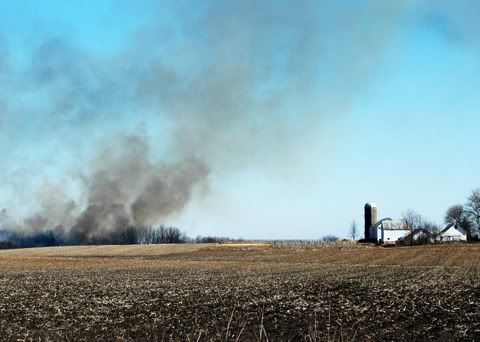
This starts the season for prairie burns, either purposeful or accidental. Controlled burns are set and the perimeters controlled by volunteers with brooms. This was probably a brush fire that caught the adjacent prairie land ablaze. There were no volunteers patrolling the edges. The fire department showed up to watch patiently, making sure the flames didn't spread to the nearby Mongerson Farm complex.

I've just finished reading the classic story of immigrants on the prairie, "Giants in the Earth" which left me with a healthy respect for the challenges facing those pioneers. I can only imagine the terror that struck their hearts as prairie fires raged out of control, speeding across the prairie faster than a man could run.