Sunday, July 17, 2005

faith

Image hosted by Photobucket.com

Just underneath the roof peak at the Congregational Church in Lily Lake they've installed a farm light. They're essential when you're out in the middle of nowhere, and usually one is installed on a pole in the area between the house and the barn, or mounted on the barn itself. Still......they're ugly. Well, not exactly ugly, but the light they emit is greenish blue and creepy.

The cross at the apex of the steeple is unique in this area - it's illuminated at night. You can see the cross from quite a distance. Shall I mention the evening I drove past the Lily Lake Cemetery, that sits on a rise about a quarter mile from this church? As I drove down the deserted road something caught my eye. There was a single light glowing at the back of the cemetery. I was not about to check it out in the dead of night. When I returned one day to place flowers on Cody's grave the mystery was solved. Someone has installed a large candle that's protected from the ever present wind. It's on the grave of a 10 year old girl who was killed in a car accident. The graves of the younger people, and those who have more recently died, are covered with any number of mementos.

Cody's teenage friends are now young adults, 22 and 23 years old. Some still visit, many do not. But on Thanksgiving eve, I will guarantee that they all give him a thought.

Saturday, July 16, 2005

a days work

Image hosted by Photobucket.com

The tree service only spent one day on the property. I'm sure alot of hard work went into the felling of all the trees on the property. My memory isn't clear as to how many may have been dispatched, but there were at least three giant trees, and many smaller ones I call the handmaidens.

There are literally two mountains of woodchips piled close to the house, and down near the barns there are two huge logs stacked in piles. If time would have allowed I would have counted the rings on the biggest of the logs, but using my hand spread as a measuring tool (that's 8 inches) I measured the largest to be 4 1/2 feet across.

It will be interesting to do updates on what finally becomes of this piece of land.

unadorned

Image hosted by Photobucket.com

Just a week ago this farmstead would have presented a beautiful image. Many times while passing by, I longed to take a photograph of the beautiful large white house and the barns and outbuildings. The roads are narrow and there is no shoulder and I would have had to pull into the driveway.

Although this property is in the general path of development, it wasn't clear whether it had been slated for destruction. The barns were in a state of disrepair, but that's the normal state in this area. The house was obviously well cared for having been freshly painted with a small garden of perennials planted on either side of the front door. From the road it's difficult to see the lower part of the drive and the garage, and although I never saw any activity, I assumed that the house was still occupied.

On Wednesday there was a truck parked in the middle of the yard - "T's Tree Service". On the following day every tree was gone. The house has been stripped of it's shade and protection from strong prairie winds. You see, just a week ago this lovely property was surrounded by a half a dozen trees of various types and sizes. Included was an awesome oak tree just to the right of the house. Hanging from one of it's strong branches, itself the size of a tree trunk, a tire swing moved hypnotically in the gentle morning breeze.

Every morning I watched the tire swing move, back and forth like a pendulum, changing at intervals to a circular arc. The house, the huge oak tree and the smaller handmaiden trees all combined to create a beautiful image that made sense. This image however is cruel and obscene. The house has been stripped of it's protection, standing naked on the prairie, out of context with it's surroundings. The trees have been cut, the larger logs stacked to the left, and the smaller trees ground into mountains of wood chips. The stumps have been ground out, the yard generally ripped up and the truck has left tracks across the space.

The fate has been sealed and intentions announced with stakes and brightly colored surveyors tape. The best scenario would involve converting the house into a sales office for the coming hordes of tract homes. More likely the house will be burned as practice for the local fire department, or simply dozed under and hauled away a truck at a time with the barn wood being sold off to antique dealers.

And now my wish is that I'd taken the moment and the chance of angering the farmer by pulling into his driveway to capture a shot of the beautiful old farmhouse, hugged tightly by the oaks and maples. The farmer would have understood, of that I'm sure. Hopefully they're far away and won't bear witness to the destruction of their home.

Friday, July 15, 2005

wild hive

Image hosted by Photobucket.com

Last weekend there was an opportunity to drive out the road that follows Big Rock Creek south outside of the town of Big Rock. This is where I'd found the wild hive on a walking photography mission at the end of May.

I felt more confident about inching halfway down the steep embankment, whose base was now fully hidden by the thick cover of roadside weeds. Registered in my memory was the basic pitch and shape of the hillside and now I had the help of the sturdy and well established weeds to hold onto if I felt myself slipping.

My knowledge of bees and insects in general is lacking, and it occurred to me that I should probably read up on their behavior. Last time the bees were frantically at work building a hive. Their activity was single minded and their work seemed guided by a general consensus of what needed to be done. With that in mind as I inched down the incline, I was shocked at the hives current state of activity.

The bees were sluggish, almost as if they were drugged. The hive didn't seem any larger or any nearer being completed than the last time I visited. The hive, which was more visible, seemed to be consructed of a styrofoam-type substance, instead of the waxy material I expected to see. And most surprising of all was the appearance of the bees themselves. This time they all seemed to have developed a round waxy/translucent spot just behind their head - almost the appearance of a blister. How curious.

So now I'm off to research the bee and try to determine what has gone wrong with this hive. None of the cells are filled and it seems to be an exercise in futility. Was the queen destroyed?

Thursday, July 14, 2005

party barn

Image hosted by Photobucket.com

Gone are the days of useful work for this barn. Once home to Guernsey cows and collie dogs, the current residents include barn swallows, raccoons and feral cats. As evidenced by the broken whiskey bottles here and there, it's also host to the occasional barn party.

These are small affairs compared to the large teenage drinking parties held in the middle of 500 acre cornfields. The teens would probably never be found out and the party could continue without disturbing a soul except for that fact that the dead giveaway is 60-80 cars parked along a lonely dirt road. One of the county sheriffs was sorely angered, not only because these kids are putting themselves in grave danger by drinking and driving, but also by the fact that he had to haul the evidence - two kegs of beer - back through the cornfield to the roadway. That's a distance of probably a quarter of a mile.

The barn parties are small affairs - a couple of teens huddled in it's shelter, drinking booze and smoking cigarettes. If there's food involved the leftovers are quickly dispatched by the ever present raccoons, and all that's left are broken whiskey bottles as evidence of the barns latest incarnation.

Wednesday, July 13, 2005

the view

Image hosted by Photobucket.com

At least once a week my routine includes a visit to what will here forward be referred to as "the barn". There are hundreds of barns in Kane County, in various states of disrepair, all worthy of being immortalized on film. "The barn", however, has a couple of things going for it. First, it's accessible, in a state of ownership limbo between the developer and our tiny village. Second, it's near my place, and it's a beauty full of interesting things. And, last but not least, I've fallen in love with the place.

Author Barry Lopez talks about the love of place, and I have fulfilled some of his requirements for this relationship. Those include paying imitimate attention to a place. My eyes and my camera regularly feast on the details of this space - the beautiful aged barnwood, the crackling paint, the empty window frames and the magnificent cathedral-like space that is the hay loft.

I cannot claim to have a storied relationship with this place. I've never milked a cow, or filled the loft with hay, never having been a part of the barns working life. My storied relationship is limited to memories of the conditions, sights and sounds on image capturing missions.

The first time I ventured into the barn it was bitter cold, the kind of cold that jars your senses. It was in November and the light was that special winter light that captures pink and blue. Subsequent visits hold memories of vines creeping slowly into barn doors hanging ajar, and birds singing hymns in the rafters of the hay loft.

Lastly Lopez talks about living ethically with a place. My ethical relationship with this place is to record it's existence and it's beauty before it is no more. That day will come. There is no way to save the place, there is only creating a memory of it's working life and it's decay.

I have yet to find a way that is technically correct for capturing the hay loft. That remains elusive to me. But here is my offering for today....another look out of the milking room window. We've been here before, you and I, but the view is never quite the same, is it?

Tuesday, July 12, 2005

dennis

Image hosted by Photobucket.com

Dennis slammed ashore and did his damage. The remnants of the storm swirled in an ever widening circle up the middle of America. Unfortunately this is all that was left of his fury......these paltry water droplets, which could hardly be called raindrops. His death throes also brought lots of wind. This is the midwest, home of tornado alley, we don't need anymore wind. Got plenty, thanks anyway Dennis.

The wierd weather conditions this growing season have created what I regard as mutant corn. A normal corn plant is characterized by broad leaves that rise vertically and then gently arch back towards the ground. They're beautiful and graceful when viewed as row upon row of gently arching leaf forms.

This year the leaves are narrow, with a swordlike shape that stabs straight into the sky, as if cursing Mother Nature for not providing nourishment. Only time will tell what fruit these sabre like plants will bear.

Monday, July 11, 2005

candid portrait

Image hosted by Photobucket.com

Candid portraits have always fascinated me, and my favorite of all are those of people surrounded by their belongings, or at the very least in their element. It tells volumes about the person that you could never guess if they were posed in a studio.

Recently one of the young photographers at the newspaper was sent on an assignement to capture the image of a local woman who was turning 100. Naturally you think of a close up, showing all the lines and character than age has brought to the face. He returned with a profile shot from a distance, of the woman sitting in her living room, her space. The camera literally ate up the scene - the lace curtains, the womans easy chair, the old lamp with it's fussy lampshade, the wallpaper....the wallpaper alone spoke volumes, an old floral pattern, knick knacks and family pictures finished the scene. It was a marvelous and respectful depiction of the elderly.

This is my attempt at a candid portrait of my neighbor Marge in her element. She surrounded by the remnants of a persons life. These are the items that are left after family members have gone through possessions, choosing for themselves the meaningful, treasured or valuable objects. Left are the odds and ends of life - a few books, glassware, linens, old kitchen gadgets and odd collections that hold no draw for the bereaved. And for me? A set of era 1960's, Frank Sinatra rat pack style on the rocks glasses for my gin & tonic. Cost? 50 cents each.

Sunday, July 10, 2005

faith

Image hosted by Photobucket.com

This is architectural detail from the English Congregational Church in Big Rock, Illinois. This church is noteworthy because it is very unusual in this area. I've never seen a building with it's features anywhere in the midwest. At the top of this steeple is a cross/shape reminiscent of a ships wheel. Keep in mind that we are thousands of miles away from any ocean.

Friday, July 08, 2005

bob's TV & appliances

Image hosted by Photobucket.com

There's not one single big box store in Oregon, Illinois. You'd have to drive up to Rockford if you're looking for the chains or big department stores. Oregon is strictly mom-and-pops. You can probably tell that Bob's once housed the local movie theater. Just around the corner from Bob's is a TV repair shop. Yep, it's true, in small town America we still repair our TV's instead of buying new.

Oregon is about an hour from our place, but we've got a similar appliance store nearby called Soukup's, a family owned business run by Doug Soukup. I don't know, maybe I'm wrong but it's kind of nice to know the people you're doing business with. Doug's a great guy and I got him to buy an ad in our newspaper one time when I promised to bring him some Krispy Kreme donuts.

This winter I'll have to get a picture at R.F. Houtz's Cub Cadet dealer. They quit doing business during the lunch hour, sit around and play cards for an hour!

Thursday, July 07, 2005

working hands adorned

Image hosted by Photobucket.com

It's impolite to tell a woman's age, so let's just say that Marge and her husband have been married for 56 years. These are working hands. Hands that have probably never seen a professional manicure. They're hands with strength and characters, adorned with rings collected over the many years of conducting estate sales. Each ring has a story, known only to the original owner.

The line up changes constantly. Some rings stay on the hand for awhile and are replaced with something different, more interesting or more storied. Marge holds my five dollar bill in payment for special treasures I discovered at her barn sale - a pyrex glass pie plate and a hand-carved figurine from Indonesia.

Wednesday, July 06, 2005

berry tales

Image hosted by Photobucket.com

Picking berries fresh from the vine is a pleasant way to spent a summer's evening. As you walk along the line of brambles you are required to make a decision, over and over again. Is the berry fully ripe? Would it benefit from one more day on the vine?

Wearing long pants and being careful to avoid being caught on the thorns, I fill a small basket. The evenings efforts conjure up thoughts of blackberry jam or blackberry pie. It take several evening of picking to amass enough fruit to fill a pie and the work effort slides backwards as you sample the harvest.

Monday, July 04, 2005

big rock

Image hosted by Photobucket.com

Communities sprang up along the rail lines, at intervals determined by how much grain the grain elevator could hold. This is a typical small town scene. As grain elevator complexes go, this is a small operation. Some of the bigger operations take up many acres.

Big Rock has no stop lights, no stop signs, no traffic and no smog. It's home to the Lamb of God organic farm. For a small subscription fee you can get fresh produce throughout the season.

Independence Day

Image hosted by Photobucket.com

It's Independence Day in small town America. In this part of the midwest that means parades, cookouts and fireworks. This is Big Rock, Illinois, one of many small towns dotting the countryside. They've hung flags on the electric poles along Route 30, starting just before the Vacationland RV dealership.

Big Rock is one of the smaller towns, with just a few businesses and lots of beautiful farmland. This building houses the Big Rock Historical Society and it stands on a curving road at the edge of town.

Northern Illinois is a large hog producer, so you can bet that we'll be serving barbecued ribs and pork chop sandwiches later this afternoon. There will be homemade potato salad, baked bean, corn roasted in the husk and baked beans. Thanks for visiting our little corner of the world. Happy 4th of July!

Sunday, July 03, 2005

faith

Image hosted by Photobucket.com

It's early morning in Lily Lake. Parishoners won't be arriving at the Congregation Church for another 2 hours. The sun is just rising and a breeze has picked up. This is a detail of the stained glass windows that encircle the church. I've yet to experience the beauty of the glass from inside the church. I'm sure it's wonderful.

Saturday, July 02, 2005

used glamour

Image hosted by Photobucket.com

Margies barn sales are filled with wonderful and surprising treasures. Glassware, dishes, books and any number of items are displayed in neat arrangements, looking for a new home. Plastic tubs are filled with earrings, matched and tucked in plastic bags. Vintage bracelets fill a display case, long since separated from their owners. I wonder what stories these bracelets could tell. Tales of cocktail parties, weddings, anniversary dinners and time past when they helped add a touch of glamour on their owners wrist.

Friday, July 01, 2005

organic

Image hosted by Photobucket.com

Organic refers to not only the fact that this cabbage was grown without the use of chemicals, but also to the nature of the design. It seemed to me a much more interesting as a black and white image, although the beautiful blueish green colors of the unfolding plant are equally compelling.

Brilliant yellow/orange marigolds are planted around the perimeter of the beds in an attempt to fend off the bugs amd a phony owl purchased from the nearby Farm and Fleet store is drafted into service standing watch over the garden patch. It won't be long till this is a batch of fresh cole slaw.

Thursday, June 30, 2005

H2O

Image hosted by Photobucket.com

Farmers watch the weather reports with the same interest that New York lawyers following the stock exchange. Precipitation becomes more than just a topic of conversation if your livelihood is dependent upon Mother Nature's whim.

Thankfully a thunderstorm rolled through last night in the wee hours, and drenched the fields for a short time, giving a brief respite to the drought. The thirsty soil soaked up the meager but welcome offering. This morning my large Elegans hosta was sprinkled with precious H2O.

yucatan dreaming

Image hosted by Photobucket.com

The nearest palm tree is probably a thousand miles from the corn and soybean fields of Illinois. But thanks to a businessman who opened a car wash near here, we can pretend we're sitting on a beach in the Yucatan. The building is a Key West type architectural design, and he's had these fake palm trees installed out front.

I sat on a bench waiting for the young workers to finish vacuuming and spiffing up the interior. If you tune out the hum of the machinery and look skyward, you can almost believe that you're in Playa del Carmen. Almost. I'm not quite sure the imagination will take you there in the middle of January, but it would be worth a try.

This flatlander has found a second love and every time I leave Playa, it's with a kiss and a promise to return. I miss all the lovely, hard working people that inhabit the Yucatan.

Wednesday, June 29, 2005

wash day

Image hosted by Photobucket.com

After the wedding, student volunteers demonstrated farm life activities, including doing the laundry. Wardrobe was quite limited in those days, limited by the amount of fabric you could produce on the loom, and the time it took to launder the clothing one piece at a time.

These students are participating in an effort to keep history alive in an educational and meaningful way. I wondered if any teachers have incorporated the blogging phenonmenon into their teaching by assigning students a blog to read for a month or two. They could then produce a report on what they've learned, or a critique of style, photography or whatever the teacher deemed appropriate.

Tuesday, June 28, 2005

the vows

Image hosted by Photobucket.com

In the late 1800's, one of the Durant daughters was married in this small parlor of what is now the Durant-Peterson Museum house. There were 15 guests at her wedding. Weddings of the time were not grand affairs and most likely occurred during January or February when the work load at the farm was at it's slowest.

This reenactment portrayed a wedding of the period and featured old time wedding traditions. One of student volunteers was the bride, her friend served as her groom, and a retired history teacher served as the judge. Visitors to the museum house were enthusiastic wedding guests. It was unlikely that a rural couple in the 1800's would have had a wedding portrait taken, but in this instance I was glad to serve as re-enactment photographer.

Monday, June 27, 2005

potential

Image hosted by Photobucket.com

The violin holds potential in the hands of a talented musician, and performance is the marriage of talent, emotion and hard work.

If you were to follow my comments on other sites, you'd discover that I'm not knowledgable enough of a photographer to discuss the technical aspects of the work. As a student of human nature, and cultural and social issues, I'm always interested in the story the photo tells. If the story is not readily apparent, I make one up. I've posted two separate photos of this talented young man in hopes that my small but loyal readers will comment on the merits of each. I love the darker nature of the previous photo, but in this one John's eyes are closed which supports my vision of music flowing from deep inside, unfettered by the sheet music which he cannot see.

eloquence

Image hosted by Photobucket.com

As children, we were always encouraged to create a rich artistic life. I can't remember a single day as an adult that I haven't done something creative, whether it be writing, painting, knitting, stitching or any number of endeavors. I have, however, always been wildly envious of people who have been gifted with musical talent, because I have none of it. None.

It's one thing to be moved by a beautiful piece of music, but to be able to perform and channel emotion through the instrument must be tremendously satisfying. It will remain an experience I can only dream about.

Picture here is John, a young musician who performed for guests at a reenactment of an 1800's wedding. He performed music that would have been popular at the time, and he was very talented and poised. Many thanks to John and his sister Emma, who performed prior to the ceremony.

pop corn

Image hosted by Photobucket.com

Does it look hot and dry? It is. The corn is in danger of popping in the field.

I received an e-mail from Jerry at Garfield Farm in which he passed along the information that this is the driest early spring and summer since 1939. That fact that the corn plants are this tall and fairly healthy looking is a testament the development of drought resistant plants. The old saying is that the corn should be knee high by the 4th of July and this corn has surprisingly passed that mark.

I love to watch the fields. The perfectly spaced rows stretch as far as the eye can see. A windbreak of trees appears like a mirage on the gently curving horizon.
The corn loves basking in the heat, but only if it can be refreshed by a good rain. Mother Nature teased us mercifully last night, throwing a wave of lightning and thunder in from the Mississippi River, only to break the promise of rain. Not a drop fell on the parched earth.

Sunday, June 26, 2005

faith

Image hosted by Photobucket.com

It's all in the details.

Older buildings have fascinating details, such as this small, intricately carved element over the doorway of the First Congregational Church in Geneva. Above the cross shaped gingerbread is a curved window with stone quoin trim and above that columns and capitals crafted from wood.

Saturday, June 25, 2005

a man and his music

Image hosted by Photobucket.com

In addition to keeping his tractor in top running condition, and giving it a beautiful paint job, Avery has installed a cassette tape player. He was very enthusiastic about sharing his choice of music......lots of Swedish and Bohemian polka tapes. I had to admit I'd never heard of Swedish polkas. The only thing missing on the tractor seemed to be a cup holder, for a nice can of beer while you're plowing.

the collector

Image hosted by Photobucket.com

This is Avery Stevens, the tractor collector I met this morning. I believe he said he has at least 7 old tractors, including a Silver King, and Avery and others. Collecting is an addiction, whether it be tractors or cameras, and some are more pricey than others.

Avery is donning his gloves to tighten up the chains that hold the tractor on the flat bed trailer. Tomorrow he's driving the Minneapolis Moline in the Swedish Days Parade in nearby Geneva. That ought to give the kids a thrill - they love machinery!

minneapolis moline

Image hosted by Photobucket.com

On my way out to do errands this morning I stopped for gas at the Pride Pantry. Luck had it that pumping gas across from me was a guy hauling this beautiful 1948 Minneapolis Moline tractor to a show out in Sandwich, IL.

I struck up a conversation and asked him if I could take some pictures. People are always happy to talk about their passions, and collecting old tractors is his. He told me that after World War II, when farmers were choosing to upgrade to the bigger machines, these were languishing in barns all over the countryside. You could pick them up for $50 to $75, and he in fact had originally paid $75 for this machine. He assured me that he could now get at least $1,075, although in truth it's worth much more than that.

When I shared the pics on the LCD screen he became a critic of composition. He was unhappy about the broad banded canopy over the gas pumps, and offered to pull his truck and trailer out and in front of some nice trees to provide a suitable backdrop! And, being ever the collector he was concerned about the paint not being in pristine condition. No worries Avery - this is a working machine!

Friday, June 24, 2005

a little piece of heaven

Image hosted by Photobucket.com

"Nine miles from here", is a term you will hear me using often. It refers to the approach of development which is burning like a runaway prairie fire just nine miles from here.

The residents of an older community set aside what appears to be about 2 or 3 acres of land. Years ago it was plowed and tilled and sectioned off into small individual gardening plots, and each year the stewards of those plots raise corn, lettuce, cabbage, pumpkins, tomatoes....whatever their hearts desire.

This gentleman waters his small crop as progress looms in the background. Things look grim for these suburban farmers. The land their crops inhabit is too valuable as development fodder. At least three $500,000 homes, or one good sized strip mall could occupy this space. I wonder if they can smell imminent domain creeping down upon their little piece of heaven?

Thursday, June 23, 2005

the work glove

Image hosted by Photobucket.com

There's an eerie element to working in old barns and farms. It's an unsettling feeling created by the images themselves. As you look around you, questions arise. When's the last time a barn cat at out of the food bowl that is now filled with dirt and leaf litter? When did the huge vine take hold in the corn crib, spillling it's green harvest out the door and onto the floor? When the raccoons move in, making this space their own?

Chairs sit empty next to the grain lifting machinery. Work shirts hang rotting on nails, and gloves have fallen to the ground, dropping from the farmers back pocket. The air of abandonment hangs heavy on the space.

Wednesday, June 22, 2005

use it up

Image hosted by Photobucket.com

Use it up
Wear it out
Make it do
Do without.

This maxim certainly would have applied to the early settlers.

One of my recent finds at a barn sale was a book entitled, "This Cruel War". It's an almost complete set of letters written by a husband and wife during his service in the Civil War. Much energy and concern was spent upon the rigors of daily life. The wife would spend a large amount of time spinning and weaving. The resulting length of homespun cloth would be quite precious. They discussed at length how the fabric would be used. At first it was to become a shirt for the husband, as a Confederate soldier he complained of being poorly provisioned. But he thought to use the cloth for his children back home. After a length of fabric has served it's purpose as an article of clothing, it would have been cut into strips of cloth to construct a rag rug. Linda Saxer and one of her volunteers demonstrate the weaving of a rag rug on a small wood frame. Many thanks to Linda and other area preservationists who work hard to keep history alive.

Tuesday, June 21, 2005

mystery shopper

Image hosted by Photobucket.com

Marge and "the furniture guy" discuss business at the barn sale. Many of the rural barns have outlived their original purposes and now house antiques and tons of interesting things. Up the road from here Val has a barn full of stuff and two giant stuffed toy monkeys that reside in the rafters, serving as unofficial barn sale mascots.

I wasn't aware, until I downloaded this image, that I'd caught a mystery shopped in the old mirror hanging on the wall.

margie's free coffee & cookies

Image hosted by Photobucket.com

This is Margie. She is perhaps the most interesting person I've met in the 11 years I've lived in the country. Her and her husband built their place in 1948 on 5 acres just down the road from me. In the beginning there was no running water, indoor plumbing or central heat. In the wintertime, water turned to ice as she scrubbed her kitchen floor. She's just one of those wonderful, honest and hard working people who are the strong foundation of our community. Her and her husband continue to work - she runs antique and estate sales, and he's a farrier, shoeing horses for local farmers and equestrian centers.

Unfortunately, the new people moving in, attracted by the developers promises of "Large Homes - Less Money", will never take the time to get to know Marge. After all, she doesn't shop at the Coach Handbag store over on Randall Road.

This is probably not a very good portraits, as portraits go. The details on her sweater are blown out, and the lighting on her face a little strange. But perhaps, just perhaps, I've captured some of the "stuff" that this woman is made of. I caught her at the barn sale, and it seems fitting that she's surrounded by her stuff. I found some great little treasures, spent $11 and helped myself to her free coffee and cookies!

Monday, June 20, 2005

corn husk dolls

Image hosted by Photobucket.com

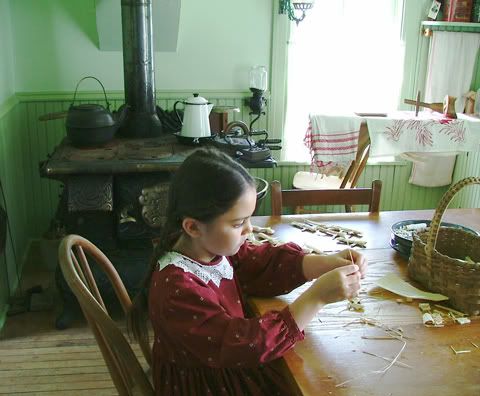
In addition to the adult volunteers, the Durant Peterson Museum House is lucky enough to have a group of school age kids who interpret the lives of the children who called this house their home. They volunteer their services for the various special presentations, including the annual Summer Frolic.

Last Sunday, three of the young volunteers were busy in the kitchen, which was added to the original house in 1880. It's always time travel for me. The girls were sitting quietly at the table, attending to their work and in the background a beautiful cast iron cookstove. If you visit in the wintertime, the stove would hold a belly of burning wood and a tasty stew would be bubbling in a pot.

A young girl who lived in the house described in her journal the advent of an exciting new pasttime - stringing buttons on thread! Times were simpler, choices were fewer, life was hard and lots of work. But those who have spent some time in the past (participants in the PBS "House" series), especially the children will tell you that it was actually less stressful and more fun!

If you're interested, you can scroll down to the next entry to see how I transformed a color photograph to a fake tintype. If you live the Chicago area, the Summer Frolic is Sunday, July 17 from 1-5 p.m.

2005 to 1880

Image hosted by Photobucket.com

This is the color photo I started with.

Usually I convert an image to monotone using the Channel Mixer mode in Photoshop, but for this purpose I needed to follow these steps:
Image > Mode > Grayscale > Discard all color information? > Click OK

This produced the following black and white image:

Image hosted by Photobucket.com

I then converted the image to a duotone:
Image > Mode > Duotone > (Drop down menu) Type > Duotone
Color #1 is black > Click on color #2 > I chose Pantone 134C

Here's the duotone:

Image hosted by Photobucket.com

In order to produce a tin type effect I then created a vignette:

Grab the Elliptical Marquee Tool and draw an oval selection where you'd like the light to fall on your subject.

Add a new layer in the layers palette. Hold the Alt. key and click once on the Layer Mask icon at the bottom of the layers palette.
Next, in the Layers palette, click on the large thumbnail of the layer you just added. The thumbnail appears all black. Press "d" to set the foreground color to black, then hit Alt-backspace to fill the layer with black.
Click on the opacity slider and set it to anywhere between 40-50% and your photo should now should have a dark border with a transparent oval in the center.
In the layers palette click once on the Layer Mask thumbnail (the thumbnail with the black oval).
Go to the Filter menu - Filter > Blur > Gaussian Blur. Pull the slider all the way to the left and start moving it to the right until your find a pleasing blend.
Click OK.
You're done.

Image hosted by Photobucket.com

Now....run out and get some vintage clothing, or find some of those Civil War reenactors and you can create yourself some fake tintypes.

barn loom

Image hosted by Photobucket.com

Our community is fortunate to have a dedicated group of historical preservationists and volunteers who maintain a number of living farms, museum houses and even a restored one room schoolhouse. Yesterday the Durant-Peterson House and the Prairie Shoals schoolhouse were open for tours. Linda Saxer and her well-trained docents demonstrate living skills from the mid 1800's. This is the barn loom that stands in the back corner of a room that was added on to the original home sometime after 1843. The loom is position between two windows, one facing east and one facing north. This provides the necessary daytime light with which to work. The loom is beautifully constructed, and make for a lovely image of wood, warp and weft.

Sunday, June 19, 2005

silo

Image hosted by Photobucket.com

The silos all have some type of ladder system to enable the farmer to climb to the top. The Harvestore at the old Anderson farm has a ladder that is built onto the outside. This is an older type silo, one made of a concrete substance, and the ladder is encased in its own space attached to the side. Silo climbing is certainly not for the faint of heart, or those afraid of heights or tight spaces.

faith

Image hosted by Photobucket.com

This is the inviting entrance to the First Congregational Church in Geneva. This town was settled by a large Swedish population and that heritage is celebrated each year during "Swedish Days". The festival, which begins on Tuesday, has lost much of it's original purpose since the area has changed dramatically over the past few years.

Saturday, June 18, 2005

a coat of many colors

Image hosted by Photobucket.com

Unlike the flighty dragonfly, who flitted nervously from plant to plant, this iridescent fly sunned himself on a broad leaf. He was quite content and although I'm sure his compound eye notice the camera moving in for a close up, he held his ground. This fly was quite small in relationship to a common housefly, and miniscule compared to a horsefly. He was a beauty though, with interesting wings that were partially transparent. He wore a coat of many colors, an iridescent cloak which glowed against the leafy background.

the secret life of weeds

Image hosted by Photobucket.com

Two barns had come down in one week, and my mood was definitely gray if not black. It occurred to me that it has been awhile since we checked in on the progress of the corn crop. With all good intentions of grabbing some corn shots, I started tramping around at the edge of the field. Every photo seemed to be boring and uninspired. In frustration I headed toward a large stand of sticky, bristly weeds near the treeline.

At this point I realized that I was walking, walking, walking aimlessly, snapping and hoping for a photograph to appear. I decided to stand still at the edge of the weed patch and take the time to slow down and observe. Motionless, I listened to the sounds - the ever present prairie wind and an unfamiliar bird call. My eyes turned towards the weeds where if you looked closely you could discern strange forms and wonderful color.

The weedy landscape changed over the following 15 minutes. A dragonfly flitted between the plant, making it impossible to catch him with the camera. Flies sunned themselves on broad leaves and butterflies danced playfully over the dangerous barbs. The thistle leaves created a canopy shading the prehistoric looking stem.

A wonderful way to spend a quarter of an hour.....slowing down and taking notice of the secret life of weeds.

Friday, June 17, 2005

just plain gone

Image hosted by Photobucket.com

The last entry was entitled, "Gone Fishing". This one - "Just Plain Gone". It's been a hard week for photographers and barns in central Kane County.

My computer crashed and the hard drive burned in a blaze of glory, taking with it a large number of photographs I hadn't yet backed up. On this score I'm fine, knowing that there are many, many other pictures out there waiting to be discovered, and in every little disaster there's a lesson to be learned.

Many times part of the process of handling disappoint involves a quiet early monring drive down one of my favorite country roads. For me it serves as a form of meditation. As you drive past all the familiar landmarks your mind becomes more peaceful and the chaos of loss is quieted. The peaceful, familiary scenes are food to the creative side.

Head north on Corron Road, past the Lenkaitis farm where dairy cows graze in the south pasture, which a noisy goose chases after the sheep in the north pasture. Further along the Corron fields stand fallow, unplanted after the township purchased them in an effort to preserve some open space in the face of development, which is tearing through the county like a runaway wildfire. The beautiful horse farm is next, on the left hand side of the road. The road turns sharply down and to the right passing the old barn at the top of the rise. I've photographed this barn many times, but my favorite time to visit is in the winter when everything is blanketed with snow. The sounds are muffled and the light is tinged with blue and pink, that special winter light that softens even the harshest edge.

I often reminise about when the baskeball hoop was used last. How many years have passed since a teenager and his farmer dad shot hoops in the barnyard?

Jim the computer guy informed me that my old hard drive was a thing of the past. I got in the car early one morning and headed out along Corron Road, past all the familiar and comforting landmarks. Down the hill and up the other side, turning right. The old barn is gone. Dismantled within the day or so that I last traveled the road. Thousands of board feet of old barnwood, gone. Huge beams, 12 inches square, carved from a single tree, gone. The mysterious basketball hoop, gone. In it's place a sign. Coming soon......a gated community for the over 55 crowd.

Coming soon? Gone.

Sunday, June 05, 2005

gone fishing

Well, not really, but The Farmers Wife must take a temporary hiatus due to a computer crash. I'm checking in on my daughters computer, which seems to be having issues also. I'm just old enough to have a love/hate relationship with technology. During this crash I will be taking photos, catching up on some reading and knitting! I'll be back as soon as Jim the Computer Geek can figure out the problem. By the way, out here in the country he makes house calls!!!

faith

Image hosted by Photobucket.com

This is some detail from the English Congregational Church of Christ in Big Rock, Illinois. The architecture is dramatically different from most of the country churches in the area, which were built by early German or Swedish immigrants.

Saturday, June 04, 2005

skeletal

Image hosted by Photobucket.com

This farmer as retired, and long since moved away from the area. He cannot, however, part with the land. That is often the case in this area. The house has been rented to a family that works in the nearby town. The farmland is also rented out, to a farmer that plants the fields. The barn is slowly deteriorating, being picked apart by elements. Wind and weather combine to serve as Mother Natures vulture, reclaiming the wood and stone long ago harvested for it's creation. It's not uncommon to find hay still in the hayloft, which never cease to amaze me. Like an earlier photography I posted here (The Work Shirt, April 19), it seems as if all work was suspended in the middle of a season. It's an almost eerie feeling. Archaeologists have discovered ancient settlements that likewise seem to have been inexplicably abandoned.

green and grey

Image hosted by Photobucket.com

The green roofing on this barn was installed a couple of years ago, using new materials. It looks oddly out of place next to the aging grey barnboard. At least the farmer has invested time and money in an attempt to stall the complete deterioration of the building. It's hard because it is quite an investment to maintain a building that no longer serves the purpose for which it was built. Money is more commonly spent on upgrades or machinery that will improve the bottom line of the farm. After all, this is a business, and livelihood for those who choose this life.

Friday, June 03, 2005

far and away

Image hosted by Photobucket.com

In answer to yesterdays question = the farms around here are large, but nothing in comparison to the wheat operations in Kansas or Saskatchewan. This picture was taken just before the fields were planted. The tight cadre of buildings is surrounded by open fields, and the farmhouses are separated by what I judge to be at least 1 or 2 miles on average. Farther west of here (about 40 miles) those distances increase by about double. The farmhouses seem very far removed from each other.

The building in this photo appear to be insignificant in size, but they are not. The silo is between 2 1/2 to 3 stories tall. This farmer plants 2,500 acres of his own property and another 17,500 acres of rented land for a total of 20,000 acres! That alot of land to plow and harvest!

Thursday, June 02, 2005

the yoke

Image hosted by Photobucket.com

A single yoke rests against the fence. It has a beautiful form, carved from maple. The wood has taken on a patina that comes with age and wear, and creates an interesting image of a tool. Unlike like most modern industrial designs, this is an organic form.

Wednesday, June 01, 2005

rural symbol

Image hosted by Photobucket.com

Not many people have even seen the small town of Holcomb. Made up of only perhaps 25 homes, the town nestles in the middle of cornfields. Corn and soybeans stretch as far as the eye can see. A railroad spur borders the town on the east, but it is rarely if ever used. Grain elevators are the dominant feature on the landscape, rising up from the flat expanses like shining minarets. They are the symbol of a lifestyle in middle America. Hard work, honesty, family, faith and country.